
If you parent a teenage boy who struggles with pornography, you likely navigate a painful mix of fear, heartbreak, and confusion. You might wonder where your motivated, curious boy went and why he now seems isolated, irritable, or emotionally distant.
To help him break free, you must first recognize that this issue extends beyond a moral lapse or a lack of willpower. Instead, the mechanics of the modern digital landscape actively hijack his biological reward system.
Fast Dopamine vs. Slow Dopamine: The Neurological Hijack
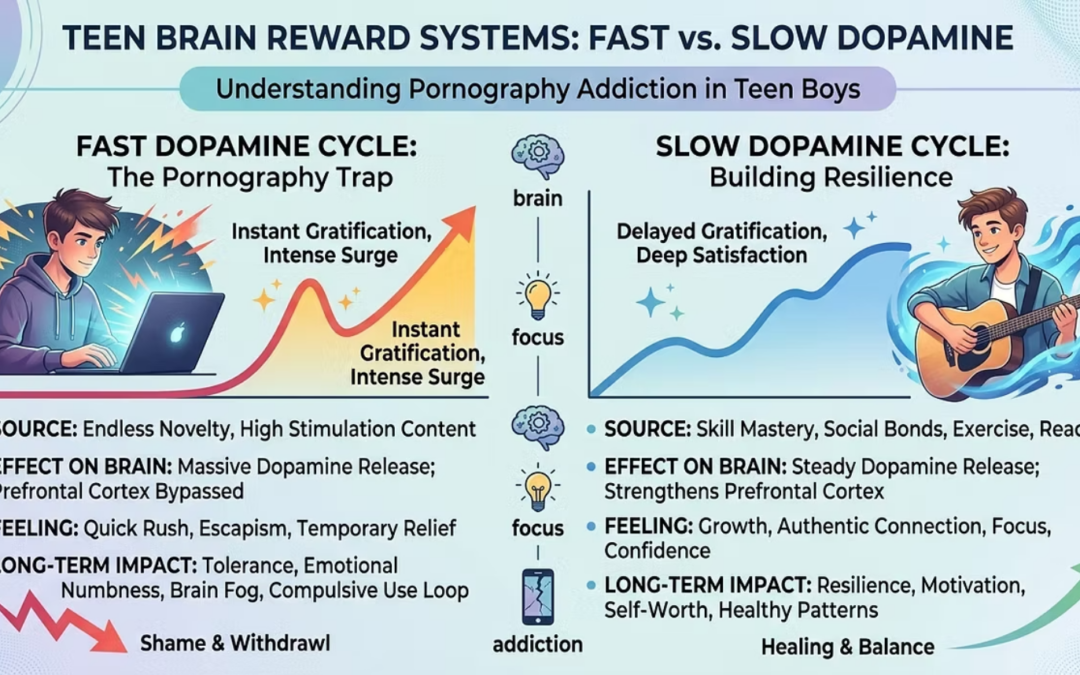
In The Anxious Generation, social psychologist Jonathan Haidt explores how technology fundamentally alters the developing brain through two distinct pathways: Fast Dopamine and Slow Dopamine.
| Feature | Fast Dopamine (e.g., Pornography) | Slow Dopamine (e.g., Real Relationships) |
| Reward Speed | Instant, effortless spike | Delayed, earned reward |
| Brain Impact | Floods nucleus accumbens | Builds prefrontal cortex |
| Receptor Effect | Desensitizes receptor sites | Strengthens resilience & focus |
| Long-Term Result | Requires higher dosage (tolerance) | Sustains long-term motivation |
- Slow Dopamine (Effort-Based Reward): Evolutionarily, nature wired the human brain for slow dopamine. A teen releases this neurotransmitter when he works hard to master a guitar riff, builds physical strength in the gym, studies to pass a tough exam, or navigates real-world dating. Because slow dopamine requires patience and delayed gratification, it actively strengthens neural pathways in the prefrontal cortex—the region that governs impulse control, focus, and emotional regulation.
- Fast Dopamine (Instant Stimulation): Conversely, fast dopamine demands zero effort while yielding an immediate, massive surge of chemical rewards. Algorithmic social media, endless video feeds, and high-speed online pornography deliver fast dopamine directly to the brain’s pleasure center.
Consequently, when high-definition, novelty-driven online pornography floods a teenage boy’s developing brain, it delivers a dose of fast dopamine far beyond anything nature intended. As Dr. Anna Lembke, professor of psychiatry at Stanford University and author of Dopamine Nation, explains, the brain naturally adapts to these overwhelming spikes by reducing its dopamine receptors.
This mechanism creates tolerance. Over time, normal real-world experiences—like playing sports, sitting in a classroom, or making eye contact with a peer—feel flat and unrewarding. Ultimately, the brain rewires itself to seek the next quick hit just to feel baseline normal, driving a continuous cycle of compulsive behavior.
Case Scenario: How the Cycle Unfolds
Consider how this dynamic typically unfolds for a 15-year-old high school student named Ethan:
- The Trigger: Ethan begins his afternoon feeling overwhelmed by academic pressure and social anxiety. Sitting down at his desk to do homework, stress and boredom quickly settle in. Consequently, he opens a browser tab for high-speed pornography.
- The Spike: Within seconds, fast dopamine floods his brain, instantly numbing his emotional distress.
- The Crash: However, as the initial high fades, a steep “dopamine crash” follows. Intense shame, mental brain fog, and physical exhaustion replace his temporary relief.
- The Isolation: Because real-world activities feel unstimulating compared to extreme digital input, Ethan retreats deeper into his room. As a result, his parents notice that he becomes increasingly secretive, quick to anger, and unmotivated.
Ethan is not inherently “bad” or weak-willed; rather, digital overstimulation has systematically rewired his brain’s baseline reward system to depend on fast dopamine.
Disrupting the Pattern: Evidence-Based Interventions
Because digital overstimulation creates this problem, parents cannot fix it simply by taking away a phone or enforcing stricter rules. Instead, breaking a deep-seated fast-dopamine dependency requires structured environmental changes, neurobiological resets, and professional guidance.
1. The Recovery Toolbox for Teens
To break the compulsive habit loop at home, teens need clinical tools designed specifically for adolescent brain development. Structured programs like The Recovery Toolbox for Teens provide evidence-based frameworks that help young men:
- Identify Triggers: Recognize the specific emotional states—such as boredom, stress, or loneliness—that spark the urge for fast dopamine.
- Build Distress Tolerance: Develop tangible, real-world coping mechanisms to ride out intense urges without acting on them.
- Recalibrate the Prefrontal Cortex: Practice cognitive-behavioral tools that restore executive functioning and self-regulation over time.
2. Star Guides Wilderness Therapy
When pornography use becomes deeply entrenched and creates severe isolation, emotional dysregulation, or family conflict, teens often need an immersive environment to break the cycle.
Star Guides Wilderness Therapy provides a specialized, evidence-based intervention designed specifically for adolescents who struggle with compulsive sexual behaviors and digital addictions. By placing teen boys in a therapeutic outdoor setting, Star Guides achieves several vital clinical goals:
- The Ultimate “Dopamine Reset”: Removing all screens and artificial stimulation allows the brain’s dopamine receptors to recover and return to a healthy baseline.
- Re-anchoring in Slow Dopamine: Wilderness living demands genuine effort, real-world problem solving, physical exertion, and direct peer connection—the exact activities that rebuild healthy slow-dopamine pathways.
- Specialized Clinical Care: Under the guidance of licensed therapists who specialize in adolescent process addictions, teens process underlying trauma, shame, and emotional distress in a safe, supportive setting.
Hope for Healing
If your son feels trapped in the cycle of fast dopamine and pornography, take heart in the fact that his brain possesses remarkable neuroplasticity. With the right interventions, clear boundaries, and structured clinical support, he can recalibrate his reward system, rebuild his self-esteem, and step back into a life of authentic, real-world connection.
Learn More
To explore how modern technology impacts the adolescent brain further, watch this discussion on how rapid digital rewards alter motivation and healthy development: Jonathan Haidt on Quick Dopamine vs Slow Dopamine. This clip provides clear context on how fast dopamine hijacks youth motivation and explains why structured intervention is essential.