
As parents, we watch our teenage sons grow physically at an astonishing rate. They outgrow their clothes overnight, their voices deepen, and their shoulders broaden.
Inside, however, a critical, invisible process unfolds: emotional maturation.
Adolescence serves as the ultimate training ground where young men learn to navigate complex, uncomfortable emotions like failure, loneliness, anxiety, rejection, and boredom.
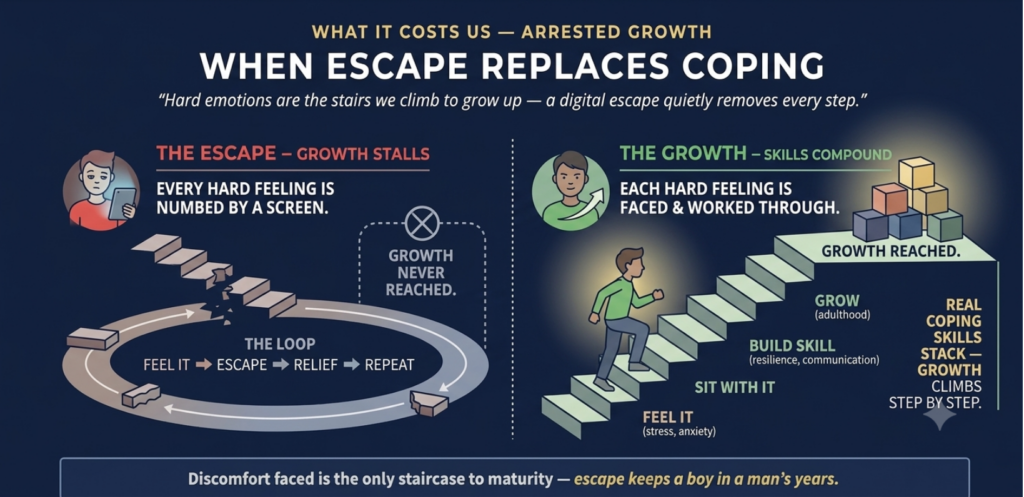
The Staircase Analogy: Hard emotions act as the steps we climb to reach adulthood—a digital escape quietly removes every step.
When a young man turns to pornography as his primary response to stress, he does far more than view explicit content. He introduces a powerful digital escape mechanism that fundamentally rewires how he handles real life, leading directly to arrested emotional development.
The Cost of the Loop: How Growth Stalls
When pornography becomes a primary coping mechanism, it functions as an emotional circuit breaker. Every time a difficult feeling arises, an immediate, overwhelming flood of dopamine numbs the discomfort.
Comparing the two distinct paths a teen can take reveals how digital escape stalls psychological growth:
Path 1: The Escape Loop (Growth Stalls)
- Feel It: The teen experiences a natural adolescent stressor (academic pressure, social anxiety, or low self-esteem).
- Escape: He immediately retreats to online pornography to avoid the negative sensation.
- Relief: A chemically induced, artificial numbness masks the problem temporarily.
- Repeat: Because he never resolves the underlying emotional trigger, the cycle locks in.
The Result: Growth never occurs. The loop repeats entirely on flat ground. Because the teen never sits with his distress long enough to solve the problem, he never builds actual emotional coping skills.
Path 2: The Growth Path (Skills Compound)
- Feel It: Facing raw, uncomfortable adolescent emotions head-on.
- Sit With It: Tolerating distress without immediate distraction or screen-based self-soothing.
- Build Skill: Navigating the problem, communicating, seeking support, and developing personal resilience.
- Grow: Moving up the staircase toward healthy, mature adulthood.
Discomfort faced serves as the only real staircase to maturity—escape keeps a boy trapped in a man’s body. If a son relies on a screen to regulate his internal world, he may reach his twenties or thirties physically while remaining anchored to the emotional maturity of a young teenager.
Disrupting the Cycle: Evidence-Based Pathways
Willpower alone rarely breaks the momentum of a neurochemical loop. The adolescent brain requires structured, therapeutic frameworks to disrupt the addiction and rebuild the missing stairs of coping development.
| Intervention | How It Helps | Best Suited For |
| The Recovery Toolbox for Teens | Focuses on active skill acquisition through cognitive-behavioral exercises, mindfulness practices, and relapse prevention strategies. Teaches teens how to recognize triggers, navigate the “urge wave,” and handle distress in real time. | Teens who need actionable coping mechanisms, daily structure, and clear boundary-setting tools within the home. |
| Star Guides Wilderness Therapy | Removes the digital landscape entirely by placing young men in an outdoor therapeutic environment. In the wilderness, screens cannot hide discomfort; boys must rely on peers, face real-world challenges, and work closely with specialized clinicians. | Teens struggling with deep-seated compulsions where home-based or outpatient care hasn’t broken the cycle of escape. |
Hope for Parents
Arrested development does not mark a permanent sentence—it represents a temporary delay. The adolescent brain possesses incredible neuroplasticity. The moment you systematically remove digital escape and replace it with evidence-based guidance, your son resumes his journey up the staircase to maturity.
By investing in specialized tools like The Recovery Toolbox for Teens or specialized programs like Star Guides Wilderness Therapy, you do more than interrupt a harmful behavior—you restore your son’s path to mature manhood.
Have you noticed your son struggling to handle everyday stress or emotional setbacks without turning to a screen? Share your experience in the comments below, or reach out to our admissions team at Star Guides to discuss the best path forward.