
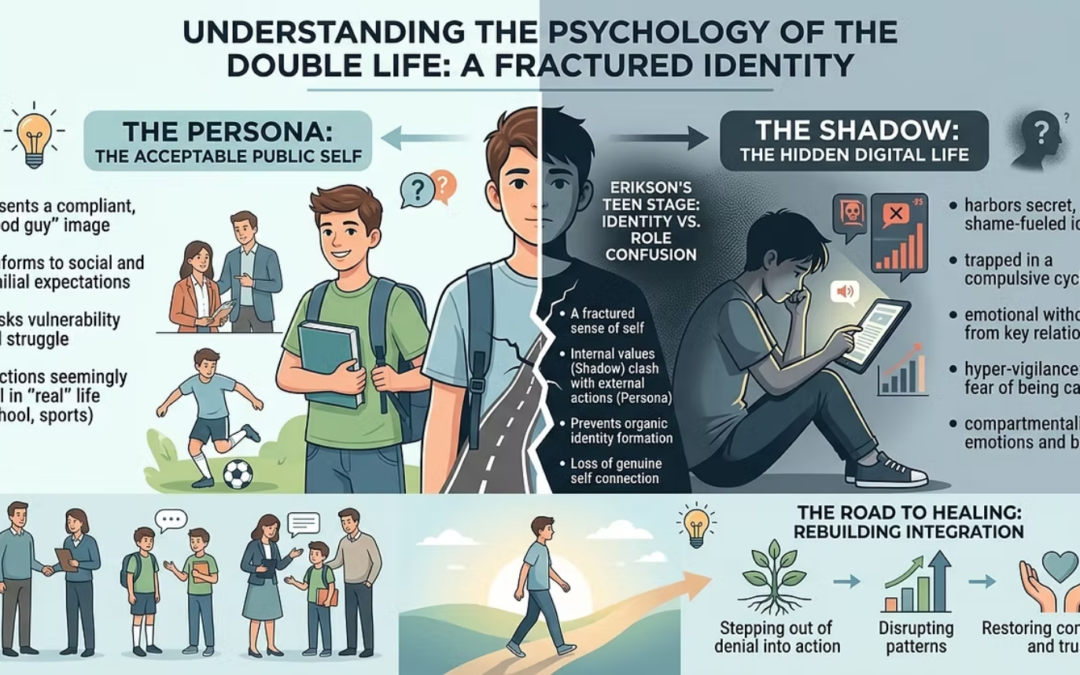
When a teenage boy’s pornography habit turns into a compulsive loop, his development is sharply disrupted. Instead of building a unified identity, he is forced to build a hidden addition. The result is a fractured self, where his internal world no longer matches the version of himself he presents to the world.
Understanding why this happens—and how to address it with clinical clarity and steady support—helps you move past shock and take action to help him heal.
The Psychology of the Double Life
In developmental psychology, Erik Erikson identified the central task of adolescence as Identity vs. Role Confusion. A teen needs to experiment, make mistakes, and learn who he is.
Compulsive pornography use traps a young man in perpetual role confusion, forcing him to maintain two distinct identities:
- The Persona: The compliant “good guy” presented to parents, teachers, and peers. He earns good grades, plays sports, and stays out of trouble.
- The Shadow: A secret, shame-fueled identity rooted in the digital world, hidden behind locked doors and private tabs.
This division keeps him from growing organically. He becomes an actor playing a role, losing touch with his genuine self before he has the chance to fully form it.
What the Research Tells Us About the Teen Brain
Understanding adolescent neurobiology removes much of the mystery—and the personal stigma—surrounding this struggle.
- The Prefrontal Cortex Gap: The prefrontal cortex—responsible for impulse control, long-term planning, and emotional regulation—does not fully mature until a person reaches their mid-twenties. Meanwhile, the limbic system (the brain’s reward center) operates at peak intensity during puberty.
- The Neuroplasticity Double-Edged Sword: Teen brains undergo rapid synaptic pruning and high neuroplasticity. High-speed digital pornography delivers artificial, supernormal spikes of dopamine. Because his brain is so malleable, repeated exposure carves deep neural pathways quickly, turning curiosity into a chemical compulsion far faster than it would in an adult.
- Relational Detachment: Research on media exposure indicates that frequent pornography consumption correlates with higher social anxiety, emotional withdrawal from caregivers, and skewed expectations of real-world intimacy.
- High Limbic / Reward Drive: Puberty primes the brain’s reward system to operate at peak intensity.
- Supernormal Dopamine Trigger: Exposure to high-speed digital pornography delivers intense, artificial dopamine spikes.
- Neural Pathway Reinforcement: High neuroplasticity in the malleable teen brain rapidly carves out deep reward loops.
- Impaired Impulse Control: The immature prefrontal cortex struggles to override or suppress powerful compulsions.
- The Compulsive Cycle: Repeated exposure solidifies into an automatic behavioral loop.
Case Study: “Liam” (Age 16)
Liam was an A-student, a varsity soccer player, and an active youth group member. To his parents, he seemed to be thriving.
- The Turning Point: His mother noticed subtle shifts—falling grades in his favorite class, bloodshot eyes, and sudden defensiveness over digital privacy. Rather than issuing an ultimatum, his parents initiated a conversation grounded in curious empathy: “We’ve noticed you seem stressed and isolated lately, and we want to help carry whatever is feeling heavy.”
- The Outcome: With the secret brought into the light, Liam experienced an immediate drop in anxiety. His family set clear digital boundaries, introduced structured daily recovery tools, and engaged a licensed adolescent counselor. Within six months, Liam’s mood stabilized, his connection with his parents was restored, and he re-engaged in his offline life.
Short-Term vs. Long-Term Impacts
Living a double life takes a heavy psychological toll. The longer this division persists, the deeper these patterns take root.
| Stage | Impact Area | Psychological Manifestation |
| Short-Term (Teen Years) | Nervous System | Hyper-vigilance & Anxiety: Constant fear of exposure keeps his nervous system in perpetual fight-or-flight mode. |
| Relational | Emotional Withdrawal: Isolation driven by the fear that being truly known leads to rejection. | |
| Behavioral | Defensiveness: Internal pressure manifests as intense privacy protection, mood swings, or sudden anger. | |
| Long-Term (Adulthood) | Relational | Intimacy Issues: Difficulty forming authentic romantic bonds; viewing relationships through a lens of performance. |
| Coping | Compartmentalization: Splitting life into separate sections carries into career, marriage, and parenting. | |
| Identity | Toxic Shame: Internalizing the belief “I am a mistake” rather than “I made a mistake,” driving secondary compulsions. |
Disrupting the Pattern: Pathways to Healing
Because the teenage brain remains remarkably adaptable, this cycle can be broken before these patterns solidify into an adult identity.
1. At-Home Intervention (Early to Moderate Struggles)
For teens experiencing early or moderate compulsions, a structured, shame-free home environment is highly effective:
- Interactive Recovery Tools: Workbooks that help teens map out their specific triggers, understand the underlying neuroscience, and take ownership of their own recovery.
- The Parent Roadmap: Shift your approach from prosecutor to partner. Use direct language, establish firm digital boundaries, and provide emotional support without resorting to lectures or shame.
- Tactical Action Guides: Implement practical daily strategies—such as habit replacement, phone-free zones, and mindfulness exercises—to resist urges and rewire neural pathways.
2. Specialized Care for High-Risk Situations
When digital habits are deeply entrenched or the parent-child relationship has fractured, home-based measures may not be enough. Severe cases often require a complete environmental reset.
Programs like Star Guides Wilderness Therapy specialize in removing young men entirely from the digital ecosystem:
- Complete Digital Detox: Removing device access interrupts the immediate dopamine loop, allowing brain chemistry to rebalance.
- Targeted Clinical Care: Specialized therapeutic support addresses underlying trauma, emotional regulation, and compulsive behavior patterns.
- Relational Restoration: Free from daily digital distractions, the wilderness setting provides space to dismantle secrecy and rebuild parent-child relationships on a foundation of trust and openness.
Discovering that your son is living a double life is painful, but it also marks the beginning of recovery. By stepping in with directness, clinical understanding, and calm support, you can help him move out of the shadows and build a whole, integrated life.