
Finding out that your teenage son is struggling with online pornography is deeply painful for any parent. It brings an immediate wave of confusion, heartbreak, and fear. But when that digital habit begins crossing over into inappropriate, boundary-violating, or unsafe real-world actions, that fear quickly turns into sheer crisis.
When a young man’s behavior escalates, early intervention isn’t about casting blame or applying shame. It is about immediate protection, strategic redirection, and long-term healing.
The Neurological Bridge: From Screen to Real Life
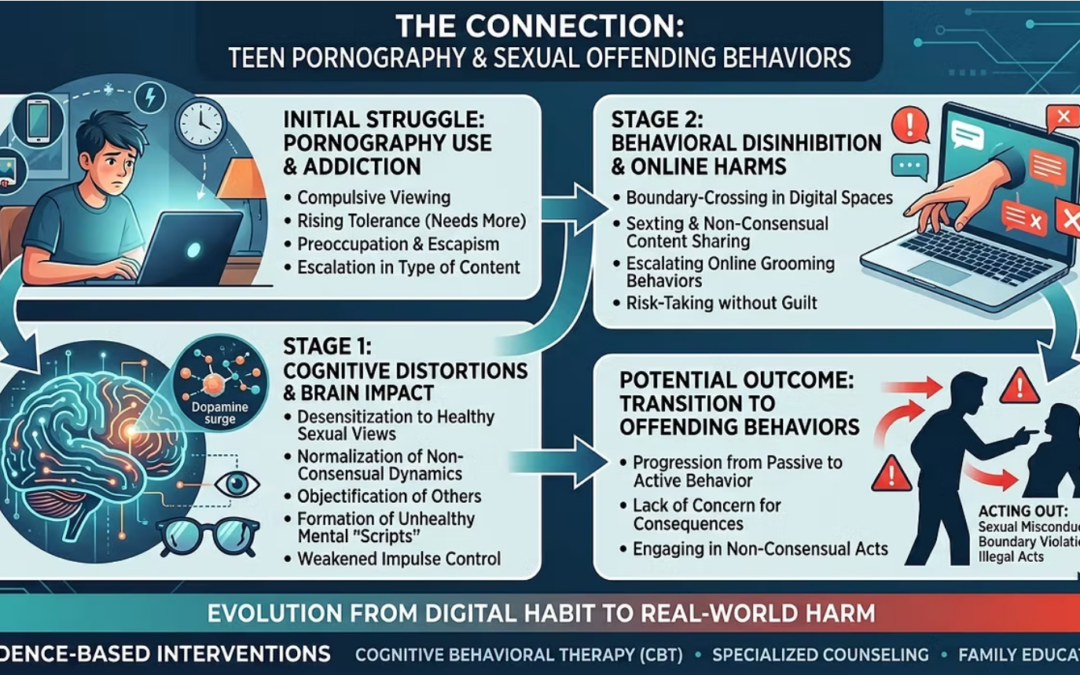
Adolescence is a critical window of rapid neurological growth, particularly in areas governing impulse control and dopamine-driven rewards. Modern high-potency internet pornography overloads these developing pathways with intense neurochemical spikes. Over time, a teenager’s brain adapts, developing a tolerance that demands more novel, intense, or extreme material to achieve the same feeling.
Forensic psychology and neuroscientific clinical data reveal three distinct mechanisms by which this online habit can transform into physical boundary violations:
- Desensitization & Escalation: Continuous consumption numb the brain’s baseline response. For vulnerable adolescents, passive watching can quickly progress to interactive digital behaviors—like sending unsolicited explicit messages—and eventually manifest as real-world physical acting out.
- Distorted Cognitive Scripts: Explicit digital content routinely portrays non-consensual dynamics, objectification, and blurred boundaries as normal. Impressionable teens absorb these depictions as mental blueprints, severely warping their understanding of mutual consent and healthy intimacy.
- Impulse-Control Depletion: Compulsive media viewing weakens the prefrontal cortex—the brain’s executive control center. This decline makes it significantly harder for a teenager to weigh real-life consequences or manage intense urges when they arise.
While pornography exposure does not automatically turn every teenager into an offender, it acts as a major catalyst for at-risk youth by eroding inhibitions and normalizing abusive dynamics.
Real-World Case Study: Understanding the Progression
Ethan’s Story (Age 15)
Ethan was an average 13-year-old when curiosity first led him to explicit online content. Over the course of two years, his viewing habits steadily escalated from basic media to violent themes, extreme video content, and interactive forums.
As he isolated himself further from family and friends, standard content no longer satisfied him. Ethan started testing boundaries online, sending non-consensual messages to girls at his school. Eventually, those eroded boundaries crossed into his physical life: during a small gathering with friends, Ethan made unwanted physical advances toward a female classmate.
Devastated by the situation, Ethan’s parents realized this was no longer a minor phase or a private bad habit. It was a destructive, escalating behavioral pattern that demanded immediate, professional intervention.
Clinical Approaches to Restoration and Healing
Effective treatment for problematic sexual behavior must look past purely punitive measures. Real transformation requires targeting the root causes—uncovering emotional dysregulation, dismantling cognitive distortions, and identifying underlying compulsive triggers.
1. Outpatient & Home-Based Recovery
For structured home support and outpatient therapy, tools like The Recovery Toolbox for Teens and the Breaking Free Workbook series provide a roadmap for progress:
- Cognitive Behavioral Therapy (CBT): Maps out individual trigger-thought-action loops so young men learn to interrupt unhealthy cycles before acting.
- Accountability & Relapse Prevention: Equips teens with concrete emotional coping skills to handle urges and reclaim self-control.
- Family System Integration: Offers targeted resources for parents to re-establish open communication and systematically rebuild broken trust.
2. Specialized Residential Care: Star Guides Wilderness Therapy
When traditional outpatient therapy isn’t enough, or when safety risks require a higher level of care, residential intervention becomes vital. Star Guides Wilderness Therapy offers a specialized, evidence-based program created tailored specifically for young men addressing compulsive sexual behaviors, pornography addiction, and severe boundary concerns.
- The Screen-Free Reset: Removing all digital media halts the constant dopamine feedback loop, allowing a young man’s nervous system to recalibrate naturally.
- Expert Clinical Oversight: Licensed therapists utilize trauma-informed care, experiential learning, and group processing to address deep-seated emotional pain and drivers.
- Practical Relational Growth: In a structured outdoor setting, students practice real accountability, gain emotional self-regulation, and establish healthy personal boundaries.
Reclaiming the Future
If your family is currently navigating this difficult path, know that lasting recovery is achievable. Because the teenage brain possesses high neuroplasticity, young men are uniquely capable of growth. With firm boundaries, specialized clinical care, and steady guidance, your son can take full responsibility for his choices, process his behavior, and build a healthy, respectful future.