
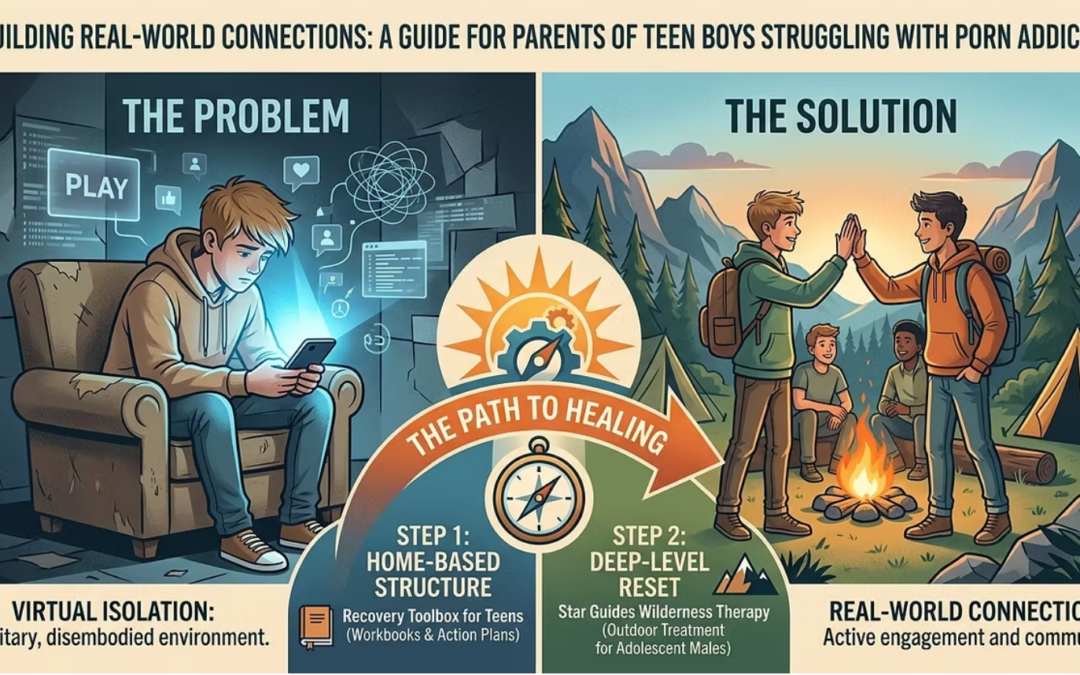
In his landmark book The Anxious Generation, social psychologist Jonathan Haidt highlights a critical truth about modern adolescence: virtual addictions thrive in disembodied, solitary environments.
When a teen boy retreats to his bedroom, turns on a screen, and compulsively views pornography, he isn’t just seeking dopamine. He is escaping into a frictionless environment where everything feels controllable. However, this digital isolation starves his developing brain of real-world human connection, physical effort, and authentic relational skills—creating a loop where deeper isolation drives deeper retreat.
Willpower alone won’t break this cycle. Simply removing a device leaves an emotional vacuum. Sustainable healing requires filling that space with structured routines, tangible hands-on experiences, and meaningful real-world connection.
1. Ditch the Shame, Focus on the Brain
Reframing pornography use as a moral failure often drives adolescent boys deeper into secrecy and shame. To support recovery, look through the lens of neurobiology:
- High-Dopamine Overload: Constant digital triggers rewire the teenage brain to expect immediate, effortless rewards.
- The Baseline Drop: Away from screens, a teen’s natural dopamine levels drop, resulting in irritability, anxiety, and intense boredom.
- The Dopamine Pivot: Recalibration requires replacing “cheap dopamine” (screens) with “slow dopamine” (physical effort, face-to-face bonds, and tangible accomplishments).
2. Practical Home-Based Healing: The Recovery Toolbox for Teens
Recovery often begins at home with clinical tools designed specifically for adolescent boys. A key resource for this stage is The Recovery Toolbox for Teens, a three-workbook bundle grounded in cognitive-behavioral principles:
| Workbook | Primary Focus | Key Benefit |
| The Breaking Free Workbook | Root-Cause Analysis | Helps boys identify specific triggers, emotional patterns, and stress responses. |
| 101 Tips for Quitting Porn | Actionable Daily Habits | Provides real-time urge management strategies and active offline hobbies. |
| The Parents Workbook | Family Alignment | Equips parents with non-defensive communication tools and boundary frameworks. |
This structured approach replaces vague promises like “I’ll do better” with concrete daily habits.
3. Deep-Level Recalibration: Star Guides Wilderness Therapy
When digital triggers and environmental patterns in the home are too entrenched, an immediate, total reset becomes necessary. This is where Star Guides Wilderness Therapy provides a specialized solution.
Located in the high desert of Southern Utah, Star Guides is a Joint Commission-accredited outdoor program built specifically to treat adolescent males struggling with technology addiction and compulsive sexual behavior.
| Phase | Core Environment | Key Outcome |
| 1. Digital Isolation | Screen-bound & solitary habits | Identifies root triggers & breaks the dopamine cycle |
| 2. Wilderness Reset | Complete unplugging & field therapy | Calms the nervous system & rebuilds self-reliance |
| 3. Embodied Connection | Physical effort & peer accountability | Establishes healthy real-world bonds & lasting habits |
Core Components of the Star Guides Approach:
- Complete Digital Unplugging: Removing screens and algorithms gives the central nervous system an immediate opportunity to reset.
- Embodied Physical Reality: Teens hike, set up camp, prepare meals, and master primitive survival skills—triggering natural dopamine through physical achievement.
- Relational Healing: Small, single-sex peer groups foster genuine, face-to-face friendships built on vulnerability rather than online performance.
- Specialized Clinical Oversight: Licensed psychotherapists specializing in adolescent trauma and sexual health conduct intensive individual and group therapy in the field.
Reclaiming Your Son’s Real World
Anonymity and isolation fuel digital addictions. Healing happens in the open—through shared family conversations, physical effort, and real-world responsibilities.
Whether your family begins with the structured exercises in The Recovery Toolbox for Teens at home or requires the immersive therapeutic environment of Star Guides Wilderness Therapy, recovery is entirely achievable. Your son is not broken; his brain is simply caught in a digital loop that can be unlearned through the right guidance and real-world connection.