
Discovering that your teenage son is struggling with pornography can feel like a sudden, devastating punch to the gut. It’s natural for your first instinct to be hyper-vigilant: searching his room, locking down his screen time, or agonizing over where things went wrong.
In the desperate search for answers, it’s easy to focus entirely on the technology—the smartphones, high-speed Wi-Fi, and endless online accessibility.
However, neurobiological and psychological research reveals a different reality: pornography addiction is rarely just about availability. More often, it’s an attempt to self-medicate a deeper, quieter ache: internalized emotional distress.
To help our sons truly heal, we have to look beyond the screen and connect the dots between how young men process their emotions and their vulnerability to compulsive behaviors.
The Hidden Connection: Internalized Pain and Addiction
From a young age, teen boys are inundated with cultural pressure to “man up,” suppress vulnerability, and hide fear or sadness. When young men lack the tools or permission to vocalize what they feel, they internalize their emotions. Grief, loneliness, anxiety, and inadequacy are bottled up inside.
Psychological research consistently shows a direct link between emotional internalization and addictive behavior. According to the Journal of Adolescence, teenagers who habitually hide their distress are at a significantly higher risk for developing behavioral addictions, including compulsive internet and pornography use.
Here’s why this happens at a neurological level:
- Chronic Discomfort: Unexpressed emotions leave the brain in a constant state of psychological stress.
- The Brain’s Shortcut: Unable to articulate his pain, a teen boy’s brain searches for a quick escape.
- Dopamine Flood: Pornography provides an immediate, intense surge of dopamine.
For a young man drowning in unexpressed anxiety or isolation, the screen acts as an artificial emotional regulator. It offers instant numbing, temporary distraction, and a false sense of control. Over time, the brain maps a dangerous shortcut: When I feel emotional pain, this is how I escape it.
The Shield of Emotional Literacy
When we shift the paradigm, the results are powerful. Teens who develop emotional literacy—the ability to accurately identify, label, and express their feelings—demonstrate remarkable resilience against addiction.
When a young man can say out loud, “I feel completely overwhelmed by school,” or “I feel isolated and left out by my friends,” something transformative happens biologically.
The Neuroscience of Expression: The physical act of labeling an emotion shifts psychological activity away from the reactive, impulsive part of the brain (the amygdala) and into the rational, processing center (the prefrontal cortex).
Research published in Development and Psychopathology highlights that high emotional regulation serves as one of the strongest protective factors against substance use and behavioral dependencies in adolescents.
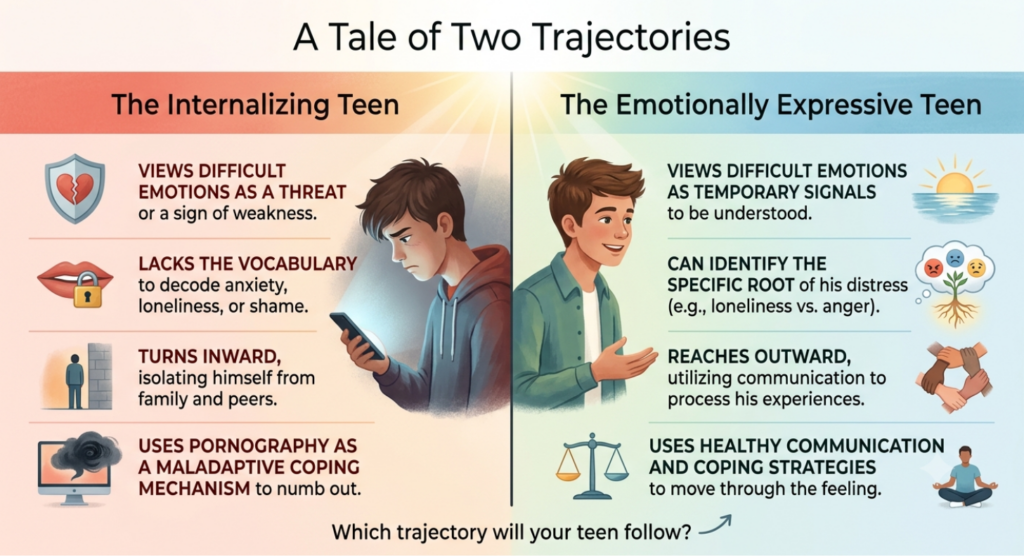
A Tale of Two Trajectories
Understanding how your son processes his internal world can help you identify where he needs support:
| The Internalizing Teen | The Emotionally Expressive Teen |
| Views difficult emotions as a threat or a sign of weakness. | Views difficult emotions as temporary signals to be understood. |
| Lacks the vocabulary to decode anxiety, loneliness, or shame. | Identifies the specific root of his distress (e.g., loneliness vs. anger). |
| Turns inward, isolating himself from family and peers. | Reaches outward, using communication to process experiences. |
| Uses pornography as a maladaptive coping mechanism to numb out. | Uses healthy communication and coping strategies to move through the feeling. |
Disrupting the Cycle: Evidence-Based Pathways for Parents
If your son is caught in the cycle of pornography addiction, willpower and screen restrictions alone are rarely enough. Because the issue is rooted in emotional regulation and neurobiology, the solution must be equally comprehensive.
There are proven, evidence-based pathways designed specifically to help young men rewire their coping mechanisms and rebuild their lives.
1. Establish Structure at Home: The Recovery Toolbox for Teens
For families looking to build structure, transparency, and emotional growth at home, The Recovery Toolbox for Teens offers a structured, evidence-based framework.
This resource includes targeted tools like the Breaking Free Workbook and 101 Tips for Quitting Porn, alongside a guide for parents. Rather than demanding cold-turkey abstinence, it uses cognitive-behavioral techniques to help teen boys:
- Identify their specific emotional triggers.
- Unpack why they turn to the screen.
- Develop tangible, healthy habits to replace compulsive behaviors.
It bridges the communication gap between parent and child, creating the open environment needed to foster emotional literacy.
2. Immersive Healing: Star Guides Wilderness Therapy
Sometimes, the addictive cycle is so deeply entrenched—or paired with severe isolation and technology dependence—that it cannot be safely disrupted at home. In these acute cases, Star Guides Wilderness Therapy provides a premier, clinically sophisticated intervention.
Operating in the high desert of Southern Utah, Star Guides is a specialized outdoor behavioral healthcare program designed explicitly for adolescent males struggling with compulsive sexual and technology behaviors.
By removing digital noise entirely, Star Guides places young men in an “unplugged” environment supported by licensed, trauma-informed therapists. Through primitive outdoor living, group processing, and individual therapy, boys learn to:
- Master emotional regulation and honest communication.
- Practice real-time personal accountability.
- Face their internal emotional landscape without a screen to hide behind.
Moving Forward
Pornography addiction in teen boys is fundamentally a battle over emotional coping. By helping our sons move away from internalizing their pain and toward expressing it, we don’t just protect them from an addiction—we guide them toward becoming emotionally resilient, authentic young men.
Whether you start the conversation tonight using structured home resources or explore the transformative environment of wilderness therapy, know that recovery is entirely possible. You don’t have to walk this path alone, and neither does your son.
To learn more about how experiential treatment models help adolescents overcome sensitive issues free of shame, watch our video overview of the Star Guides program.