
If you are a parent sitting in the quiet heartbreak of discovering that your teenage son is struggling with compulsive pornography use, your mind is likely racing with heavy, painful questions:
- Where did we go wrong?
- Why doesn’t he just stop?
- Why isn’t his character, faith, or love for our family enough to make him put the screen away?
It is completely natural to view this behavior through the lens of a moral failing, a lack of self-discipline, or a breakdown in character. However, modern neuroscience offers a profoundly different—and far more compassionate—understanding.
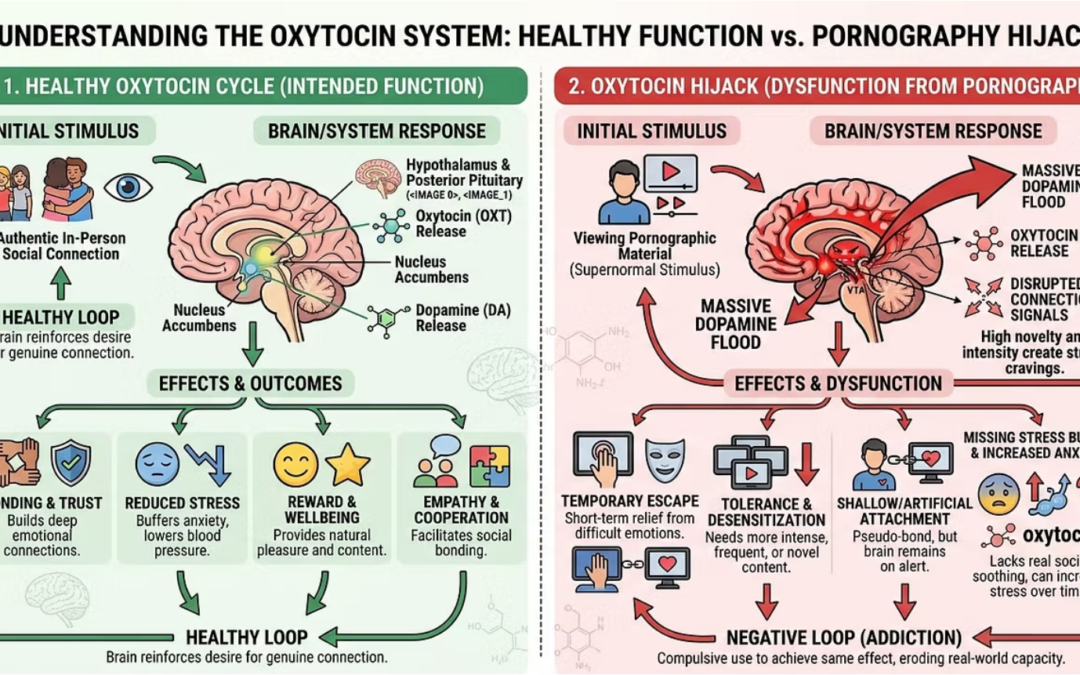
Your son is not demonstrating a lack of morality. His developing adolescent brain has experienced a neurochemical hijack—one where the brain’s natural bonding and reward systems have become entangled in artificial stimulation. Understanding the biology behind this struggle reveals a crucial truth: the real antidote to compulsive behavior isn’t willpower or shame—it is authentic, in-person human connection.
The Chemistry of the Hijack: Dopamine Meets Oxytocin
Most conversations about digital addiction focus heavily on dopamine—the neurochemical of anticipation, reward, and novelty. Dopamine is what compels a teenager to click, swipe, and constantly search for the next visual high. However, dopamine is only half the equation.
The deeper issue in pornography compulsion lies in oxytocin, often referred to as the “bonding hormone” or “cuddle chemical.”
How Oxytocin Is Supposed to Work
In healthy human development, oxytocin is released during meaningful, in vivo (real-life, face-to-face) interactions:
- Visual & Emotional Alignment: Direct eye contact and shared laughter with friends.
- Somatic Touch: Physical touch, such as a hug from a parent, a high-five from a teammate, or a handshake.
- Belonging: The felt sense of emotional safety and acceptance within a family, team, or community.
Oxytocin acts as a neurochemical anchor. It calms the amygdala (the brain’s threat center), reduces social anxiety, and signals to the nervous system: “You are safe, connected, and valued.”
How Digital Stimuli Counterfeit Connection
When an adolescent brain consumes high-definition, novelty-rich explicit content, it experiences massive floods of dopamine alongside synthetic bursts of intimacy signals. Over time, the nervous system misidentifies the screen as its primary source of emotional comfort and relief.
Instead of seeking real-world peer connection when feeling lonely, anxious, stressed, or inadequate, the teen’s brain defaults to a digital substitute. But because a screen offers no reciprocal eye contact, shared vulnerability, or genuine warmth, the oxytocin reward is shallow and short-lived.
The result is a destructive cycle: neurochemical craving followed by profound isolation and shame.
Real-Life Application: Understanding “Ethan”
To see how this neurochemical feedback loop operates in daily life, consider a common scenario:
Ethan is a 16-year-old high school junior. Between academic pressures, athletic expectations, and navigating complex social dynamics, Ethan often feels overwhelmed and subtly disconnected. When he comes home exhausted, his nervous system is hungry for relief and safety.
Instead of opening up to his parents or reaching out to friends, Ethan retreats to his bedroom and locks the door. Feeling anxious and lonely, he turns to explicit material on his phone. Within seconds, his brain experiences a massive surge of dopamine and artificial soothing signals.
An hour later, the high dissipates. What remains is a flood of shame, biological exhaustion, and deeper isolation. Ethan promises himself he will “never do it again” and vows to rely on sheer willpower.
But the next time school stress surges or he feels socially isolated, his hijacked nervous system remembers the quickest pathway to neurochemical relief. Willpower alone cannot quiet a brain wired to crave connection and comfort.
The Solution: Real-World, In-Vivo Connection
Because this neurochemical loop was built through false connection, it can only be re-wired through genuine human connection. You cannot heal a relational injury in isolation.
To help a young man recover, we must replace digital hyper-stimulation with rich, real-world experiences:
- Facial Expressions & Eye Contact: Neurological regulation happens when eyes meet eyes. Real-life presence signals to the nervous system that safety is real.
- Shared Somatic Activity: Physical exertion, outdoor engagement, and team challenges release natural endorphins and oxytocin, restoring healthy reward pathways.
- Vulnerable Community: Being truly known and accepted by mentors and peers—without fear of judgment—breaks the cycle of shame.
Evidence-Based Pathways to Recovery
Overcoming a neurochemical hijack requires concrete tools and immersive environments designed specifically for adolescent brain development.
1. The Recovery Toolbox for Teens
To transition away from automatic digital habits, teens need structure, self-regulation skills, and practical accountability. Providing teens with an evidence-based framework equips them to:
- Identify emotional triggers and early warning signs.
- Navigate intense dopamine cravings without acting on them.
- Cultivate healthy, real-world coping mechanisms.
- Rebuild self-worth and identity outside of shame loops.
2. Star Guides Wilderness Therapy
When digital addiction and sexually compulsive behaviors become deeply entrenched, removing the adolescent from their saturated digital environment is often necessary to allow the nervous system to recalibrate.
Star Guides Wilderness Therapy is a specialized, evidence-based intervention designed specifically for adolescents struggling with sexually compulsive behaviors, digital addiction, and underlying trauma. By placing young men in an immersive outdoor environment, Star Guides accomplishes key therapeutic objectives:
- Complete Digital Detox: Removes all digital noise, allowing over-stimulated dopamine and oxytocin receptors to reset to baseline levels.
- In-Vivo Relational Healing: Utilizes team-based wilderness living where young men build real-life trust, transparent communication, and authentic peer bonds.
- Specialized Clinical Mentorship: Experienced clinicians help teens uncover the root emotional drivers of their compulsion, replacing digital coping mechanisms with genuine resilience.
A Message of Hope for Parents
If your son is struggling, remember: he is not broken, and he is not a “bad kid” trying to be bad. He is a young man whose natural mammalian drive for connection has been redirected into a digital feedback loop.
By shifting your perspective from shame to understanding, you can stop fighting a battle of pure willpower and start building a bridge of connection. Healing happens in relationship—and with the right clinical tools, structured guidance, and real-world support, his brain can heal.
Opening the Door: A Parent’s Guide to Talking About Pornography Without Shame
Discovering that your teenage son is struggling with compulsive pornography use is terrifying, and the thought of bringing it up to him likely fills you with dread. Your biggest fear is probably making things worse: that he will shut down, slam his bedroom door, pull away completely, or drown in a paralyzing wave of shame.
Because shame is the exact fuel that keeps the digital addiction cycle spinning, how you approach this conversation matters just as much as what you say.
This step-by-step guide is designed to help you approach your son with empathy, grounded authority, and a focus on connection rather than punishment.
Step 1: Manage Your Own Nervous System First
Before you knock on his door, check in with your own emotional state. If your nervous system is flooded with panic, anger, disappointment, or disgust, your son’s survival instincts will pick up on it instantly. He will brace for a threat and put up a wall of defensiveness.
- Lower your weapons: Remind yourself that he is not a “bad kid” trying to hurt you; he is a struggling adolescent whose brain has been hijacked by a powerful digital loop.
- Drop the interrogation mindset: Your goal right now is not to extract a confession, hand down a punishment, or make him feel guilty. Your goal is to build a bridge of safety.
Step 2: Choose the Right Setting and Framing
Timing and environment set the psychological stage for the entire conversation.
- Avoid high-stress moments: Do not bring this up right after he gets home from school, when he is tired, or right in the middle of a conflict.
- Opt for side-by-side connection: Heavy face-to-face talks across a kitchen table can feel like an inquisition. Instead, initiate the conversation while doing something low-stakes side-by-side—driving in the car, walking the dog, or cooking dinner together. This naturally lowers eye contact intensity and reduces pressure.
- Lead with vulnerability, not accusation: Instead of starting with a direct accusation (“I know what you’ve been looking at on your phone”), start by expressing your care and your observation of his overall well-being.
What it sounds like:
“Hey, I’ve noticed you’ve seemed really stressed, withdrawn, and heavy lately. I love you, and I care about how you’re doing. I want you to know that you don’t have to carry whatever is weighing on you all by yourself.”
Step 3: Name the Hijack, Not the Character Flaw
When you do bring up the topic of pornography, frame it through the lens of neuroscience rather than morality. Normalize how easily the modern digital world can trick a developing brain.
- Acknowledge that tech companies literally engineer these platforms to hijack the brain’s dopamine and bonding systems.
- Separate who he is from what his brain is experiencing.
What it sounds like:
“I want to talk about something hard. I found out you’ve been looking at pornography. I’m not bringing this up to shame you or take away your phone as punishment. Honestly, I’ve been learning about how screens and explicit content affect the teenage brain. Tech companies design these things to give massive dopamine hits, and it’s so easy for a normal, healthy brain to get hijacked and trapped in a loop. I suspect you might be using it to cope when you’re stressed, lonely, or overwhelmed.”
Step 4: De-escalate Defensiveness Immediately
Your son’s immediate instinct will likely be denial, minimization, or anger (“Everyone does it, it’s no big deal, stop spying on me!”). How you respond to his defense mechanism will determine whether the conversation continues or shuts down.
- Do not take the bait or argue facts: If he gets defensive, do not argue back or try to prove him wrong. Validate his fear of exposure instead.
- Reassure him of your unconditional safety:
What it sounds like:
“I hear you, and I know this is terrifying to talk about. Of course you’re scared or defensive—anyone would be in your shoes. But I want you to hear me clearly: I am not mad at you. I am on your team. My job isn’t to punish you; it’s to help you figure out how to get unstuck.”
Step 5: Shift the Focus to Real-World Needs
Since pornography is often a counterfeit substitute for genuine connection, stress relief, and oxytocin, gently pivot the conversation toward what he is actually needing in his life underneath the behavior.
- Ask open-ended, non-judgmental questions about his emotional world rather than grilling him about his screen habits.
What it sounds like:
“When things get really heavy or stressful for you, what usually triggers that feeling? What are you looking for relief from in those moments? Let’s figure out together how we can get you real support, real relief, and real connection—without you having to carry this heavy secret all by yourself.”
Step 6: Co-Create a Path Forward (Involving Professionals if Needed)
Do not try to solve this overnight with a simple “promise to do better.” True healing requires structural change and support.
- Work with him to figure out supportive guardrails (like moving phones out of bedrooms at night) rather than imposing harsh, unilateral punishments that drive the behavior further underground.
- Normalize getting outside support—such as a specialized therapist or programs designed to help young men navigate digital compulsions and reset their nervous systems.
When digital addiction, pornography compulsion, and underlying emotional distress become deeply entrenched, standard home-based interventions—like setting screen limits or having weekly therapy sessions—often aren’t enough. The sheer saturation of modern digital environments constantly re-triggers the brain’s dopamine pathways before any meaningful healing can occur.
Wilderness therapy programs like Star Guides Wilderness Therapy offer a specialized, clinical intervention by temporarily removing young men from these high-stimulation environments. Rather than viewing the wilderness as a punishment, it serves as a therapeutic mirror and a safe container where an overstimulated nervous system can recalibrate.
Core Mechanisms of Wilderness Therapy for Digital & Sexual Compulsions
1. Neurological Reset (The Biological “Dopamine Detox”)
In a normal home environment, screens offer instant gratification at the press of a button. In the wilderness, all digital noise is completely eliminated.
- Baseline Stabilization: Stripping away synthetic high-dopamine hits (gaming, social media algorithms, explicit content) allows over-stimulated dopamine and oxytocin receptors to down-regulate and reset to healthy baseline levels.
- Natural Circadian Rhythms: Living outdoors aligns the body’s nervous system back to natural light cycles, dramatically improving sleep quality, mood regulation, and mental clarity.
2. In-Vivo Relational Healing
A core driver of compulsive behavior is emotional isolation—using screens to hide from real-world vulnerability or social anxiety. The wilderness environment makes isolation impossible while creating a safe framework for genuine connection.
- Team-Based Survival & Living: Day-to-day tasks—setting up camp, preparing meals, lighting fires, navigating trails—require direct communication, teamwork, and mutual trust with peers.
- Eye-to-Eye Socialization: Instead of communicating behind avatars or avatars/screens, young men engage in reciprocal facial expressions, eye contact, and shared physical exertion, which naturally triggers authentic oxytocin release.
3. Somatic Regulation & Natural Consequences
In a digital space, actions are abstract and disconnected from physical reality. The wilderness reintroduces immediate, non-judgmental natural consequences.
- Self-Efficacy & Physical Accomplishment: If a student doesn’t pitch his shelter properly, he gets wet when it rains. Overcoming physical challenges (hiking, outdoor living) builds genuine resilience and a felt sense of capability that no digital achievement can match.
- Somatic Grounding: Physical exertion paired with deep natural immersion helps release stored trauma and chronic stress from the body.
4. Specialized Clinical Mentorship
Star Guides integrates licensed, specialized clinical care directly into the wilderness environment rather than relying solely on wilderness survival skills.
- Uncovering the “Why”: Master’s-level therapists work with teens individual-to-individual and in group settings to identify the root drivers beneath the compulsion—such as attachment wounds, social anxiety, low self-worth, or past trauma.
- Building a Recovery Toolbox: Clinicians equip teens with evidence-based, practical skills to recognize emotional triggers, navigate intense cravings, self-regulate without a screen, and process shame productively.
5. Family System Integration
Sustained recovery requires a supportive home environment when the program ends. Programs like Star Guides work extensively with parents through parallel therapy, letter writing, and family workshops. This ensures that while the student is learning emotional regulation in the field, parents are building healthier communication patterns and clear home guardrails for a successful transition back home.